Welcome, Guest:
Join Badagry Forum /
Login /
Trending /
Recent
Stats: 16 members, 153 Topics. Date: April 15, 2026, 11:05 pm
Number Counting In Ogu Language (11 To 40)
Badagry Forum / General / Learn Ogu / Egun Language / Number Counting In Ogu Language (11 To 40) 245 Views
(Go Down)

 (
(
Following our previous lesson where we covered numbers 1–10 (badagryforum.com.ng/p/55/number-counting-in-ogu-language-1-10), we will now explore the next stage of our counting system.
As we move higher, you will notice how #Ogu logic combines base numbers to form larger values.
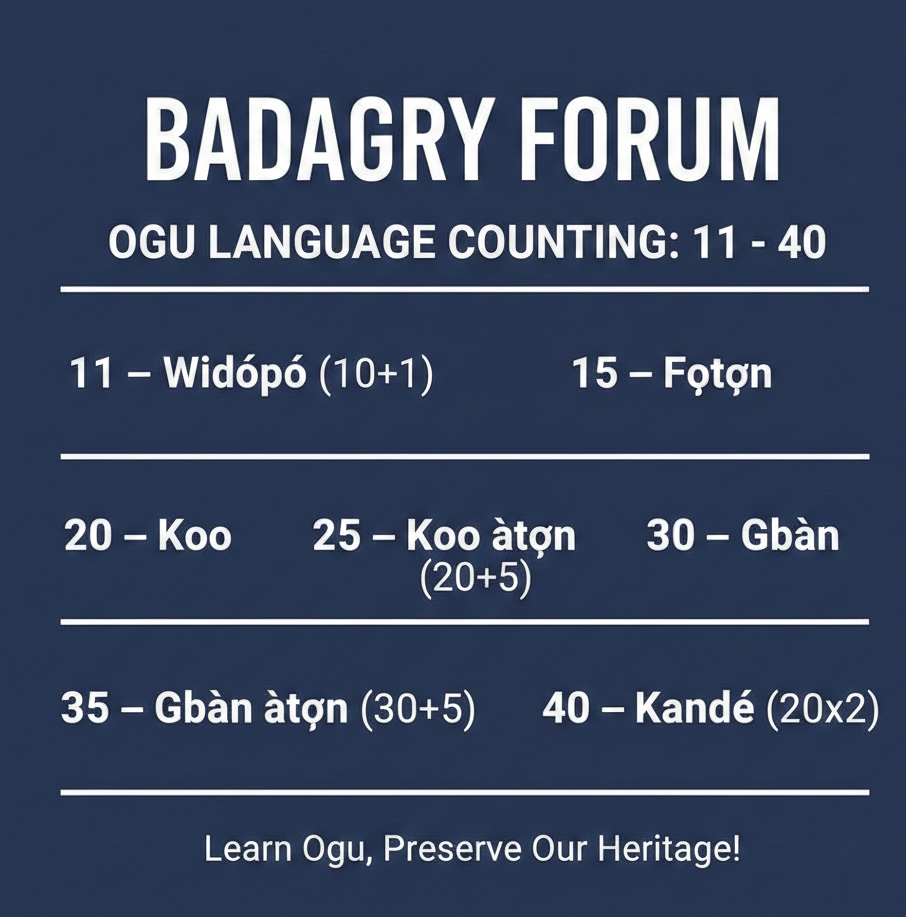
Ogu Number Counting: 11–40
In this set, we move from the base-10 (Àó) into the "teens," and eventually reach the significant milestones of 20 (Koo), 30 (Gbàn), and 40 (Kandé).
11–15
• 11 — Widòpó (10+1)
• 12 — Wiawe (10+2)
• 13 — Wiatọ̀n (10+3)
• 14 — Wiẹ̀nẹ̀ (10+4)
• 15 — Fọtọ̀n (A unique root for fifteen)
16–20
• 16 — Fọtọ̀n nukun dòpó (15 and 1)
• 17 — Fọtọ̀n nukun awe (15 and 2)
• 18 — Fọtọ̀n nukun atọ̀n (15 and 3)
• 19 — Fọtọ̀n nukun ẹnẹ̀ (15 and 4)
• 20 — Koo (The score/twenty)
21–25
• 21 — Koo nukun dòpó (20 and 1)
• 22 — Koo nukun awe (20 and 2)
• 23 — Koo nukun atọ̀n (20 and 3)
• 24 — Koo nukun ẹnẹ̀ (20 and 4)
• 25 — Koo àtọ́n (20 and 5)
26–30
• 26 — Koo àtọ́n nukun dòpó (20+5 and 1)
• 27 — Koo àtọ́n nukun awe (20+5 and 2)
• 28 — Koo àtọ́n nukun atọ̀n (20+5 and 3)
• 29 — Koo àtọ́n nukun ẹ̀nẹ̀ (20+5 and 4)
• 30 — Gbàn (A unique root for thirty)
31–35
• 31 — Gbàn nukun dòpó (30 and 1)
• 32 — Gbàn nukun awe (30 and 2)
• 33 — Gbàn nukun atọ̀n (30 and 3)
• 34 — Gbàn nukun ẹ̀nẹ̀ (30 and 4)
• 35 — Gbàn àtọ́n (30 and 5)
36–40
• 36 — Gbàn àtọ́n nukun dòpó (30+5 and 1)
• 37 — Gbàn àtọ́n nukun awe (30+5 and 2)
• 38 — Gbàn àtọ́n nukun atọ̀n (30+5 and 3)
• 39 — Gbàn àtọ́n nukun ẹ̀nẹ̀ (30+5 and 4)
• 40 — Kandé (Two scores / 40)
Linguistic Insights: The "Nukun" Connector
You will notice the word Nukun appearing frequently (e.g., Koo nukun dòpó). In the context of
Ogu mathematics:
• Nukun acts as a bridge or a plus sign (+).
• It literally translates to "on top of" or "added to." For example, 21 is "Twenty on top of one."
• Milestones: Unlike the English "teen" system, Ogu uses milestone roots like Fọtọ̀n (15), Koo (20), and Gbàn (30) to build the numbers that follow.
Quick Pronunciation & Orthography Tips
• Tone Awareness: Remember that Atòn (3) has a low/neutral tone, while Àtón (5) has a rising high tone.
• The Nasal sound: Whenever you see an "n" at the end of a number (like Gbàn or Fọtọ̀n), it indicates a nasalised vowel, similar to the French pronunciation of "bon."
As we move higher, you will notice how #Ogu logic combines base numbers to form larger values.
Ogu Number Counting: 11–40
In this set, we move from the base-10 (Àó) into the "teens," and eventually reach the significant milestones of 20 (Koo), 30 (Gbàn), and 40 (Kandé).
11–15
• 11 — Widòpó (10+1)
• 12 — Wiawe (10+2)
• 13 — Wiatọ̀n (10+3)
• 14 — Wiẹ̀nẹ̀ (10+4)
• 15 — Fọtọ̀n (A unique root for fifteen)
16–20
• 16 — Fọtọ̀n nukun dòpó (15 and 1)
• 17 — Fọtọ̀n nukun awe (15 and 2)
• 18 — Fọtọ̀n nukun atọ̀n (15 and 3)
• 19 — Fọtọ̀n nukun ẹnẹ̀ (15 and 4)
• 20 — Koo (The score/twenty)
21–25
• 21 — Koo nukun dòpó (20 and 1)
• 22 — Koo nukun awe (20 and 2)
• 23 — Koo nukun atọ̀n (20 and 3)
• 24 — Koo nukun ẹnẹ̀ (20 and 4)
• 25 — Koo àtọ́n (20 and 5)
26–30
• 26 — Koo àtọ́n nukun dòpó (20+5 and 1)
• 27 — Koo àtọ́n nukun awe (20+5 and 2)
• 28 — Koo àtọ́n nukun atọ̀n (20+5 and 3)
• 29 — Koo àtọ́n nukun ẹ̀nẹ̀ (20+5 and 4)
• 30 — Gbàn (A unique root for thirty)
31–35
• 31 — Gbàn nukun dòpó (30 and 1)
• 32 — Gbàn nukun awe (30 and 2)
• 33 — Gbàn nukun atọ̀n (30 and 3)
• 34 — Gbàn nukun ẹ̀nẹ̀ (30 and 4)
• 35 — Gbàn àtọ́n (30 and 5)
36–40
• 36 — Gbàn àtọ́n nukun dòpó (30+5 and 1)
• 37 — Gbàn àtọ́n nukun awe (30+5 and 2)
• 38 — Gbàn àtọ́n nukun atọ̀n (30+5 and 3)
• 39 — Gbàn àtọ́n nukun ẹ̀nẹ̀ (30+5 and 4)
• 40 — Kandé (Two scores / 40)
Linguistic Insights: The "Nukun" Connector
You will notice the word Nukun appearing frequently (e.g., Koo nukun dòpó). In the context of
Ogu mathematics:
• Nukun acts as a bridge or a plus sign (+).
• It literally translates to "on top of" or "added to." For example, 21 is "Twenty on top of one."
• Milestones: Unlike the English "teen" system, Ogu uses milestone roots like Fọtọ̀n (15), Koo (20), and Gbàn (30) to build the numbers that follow.
Quick Pronunciation & Orthography Tips
• Tone Awareness: Remember that Atòn (3) has a low/neutral tone, while Àtón (5) has a rising high tone.
• The Nasal sound: Whenever you see an "n" at the end of a number (like Gbàn or Fọtọ̀n), it indicates a nasalised vowel, similar to the French pronunciation of "bon."
 0 Like
Viewing this topic:
4 guests viewing this topic
4 guests viewing this topic

Sister Forums
Badagry Forum is owned and managed by Semasa Opeoluwa Hokon(semasir)
(Read BF Rules)
- Copyright © 2026. All rights reserved.
Disclaimer: Every Badagry Forum member is solely responsible for anything
that he/she posts or uploads on .
For enquiries & feedbacks send email to: badagryforum@gmail.com