Stats: 16 members, 153 Topics. Date: April 15, 2026, 11:03 pm
Sewanu Michael: Apart From Politics And Tourism, What Is Badagry’s Real Economic Identity?
Badagry Forum / General / Opinions & OP-Ed / Sewanu Michael: Apart From Politics And Tourism, What Is Badagry’s Real Economic Identity? 160 Views
(Go Down)
 (m):
11:02am on January 18
(m):
11:02am on January 18
The question, raised by Sewanu Michael in a Facebook discussion that has since gained wide attention, cuts to the heart of Badagry’s long-standing development dilemma.
While the town is often celebrated for its political relevance and rich tourism narrative, there is growing concern that neither has translated into a clearly defined, structured economic identity capable of sustaining livelihoods at scale.
According to Sewanu, the issue is not the absence of activity, but the absence of a dominant, intentional trade or industry that can be collectively recognised as Badagry’s economic backbone.
Individual businesses thrive in pockets—small trading, transport services, retail shops and personal hustles—but there is no single value chain that meaningfully absorbs youth labour, attracts large investment, or generates visible, community-wide prosperity.
This view was echoed by Whejiepon Anthony Ola, who argued that even tourism, frequently cited as Badagry’s economic future, has not yet become a lived reality for the majority of residents.
While festivals and peak-season activities create momentary excitement, the economic impact remains limited, uneven and largely invisible in everyday livelihoods. In his view, a true economic identity must go beyond periodic celebrations and become part of daily economic life.
Several contributors to the discussion pointed out that other historic towns have clearly identifiable economic strengths—industries or sectors that evolved deliberately and were protected over time. Badagry, by contrast, continues to struggle to point to a single trade sector that is consciously nurtured as a Badagry brand.
For Joseph Adagba, the conversation must move beyond “one-man businesses” to the question of industries capable of employing large numbers of people and stimulating subsidiary economic activities.
He recalled a period when major institutions and industries, such as the Lagos State Coconut Industry along the Topo–Badagry corridor, #ASCON, and the former #NIFINCO Jude Bag Factory, played significant economic roles in the area. Their collapse or relocation, he argued, left a vacuum that was never deliberately addressed. To him, political leaders must rise above party lines to revive existing potentials and attract new ones.
Others, like Fashe Pius, took a broader philosophical view, noting that Badagry is naturally endowed with the resources required for economic success. In his argument, politics should serve as a tool for policy formulation and resource utilisation, not an end in itself.
Drawing international parallels, he observed that countries such as Japan built strong economies around fishing, while others leveraged tourism or sports. Badagry, he suggested, does not lack opportunity, but rather the technocratic planning required to harness what it already has.
The conversation also exposed concerns about leadership, youth direction and education. Owolabi Ogungbe highlighted the need for deliberate industrial development, better guidance for young people, and the emergence of more visionary leadership capable of prioritising long-term economic growth over short-term interests.
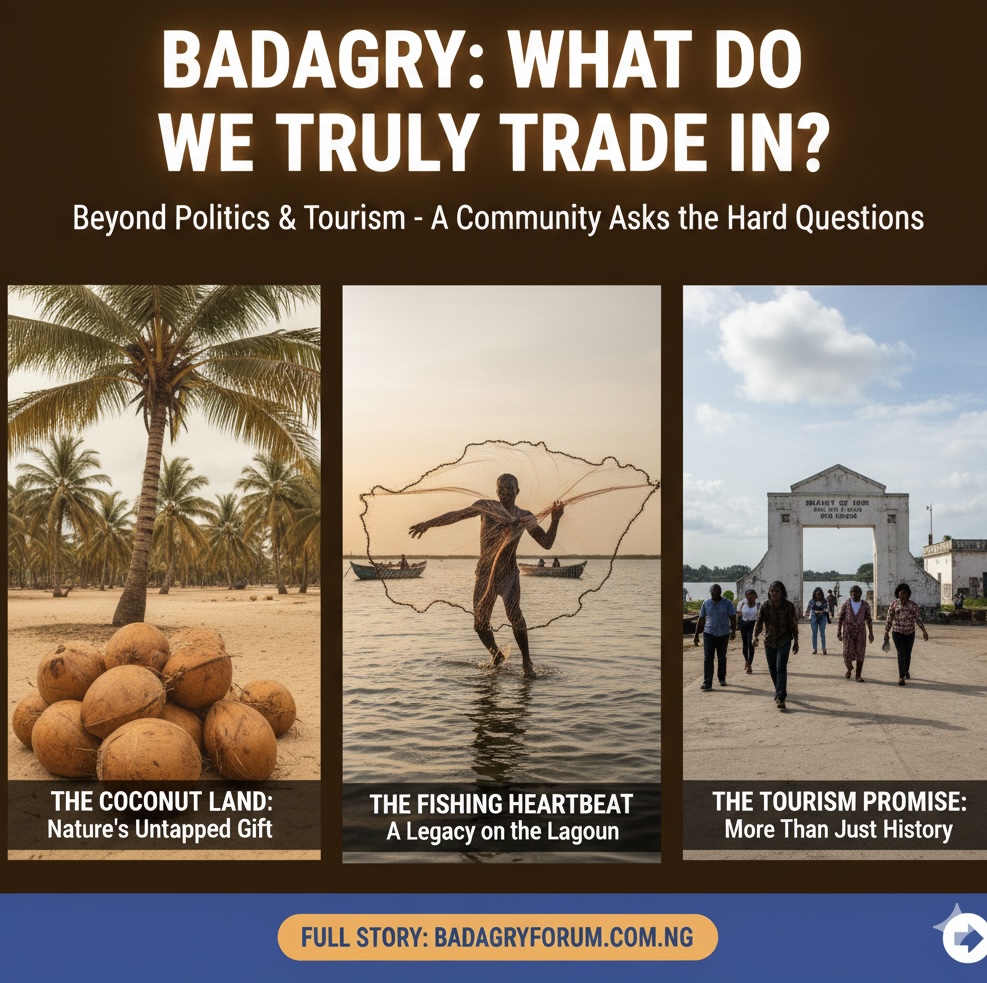
Perhaps the most grounded contribution came from voices pointing back to Badagry’s traditional economic foundations. Adewunmi Nofisat Adewale and Avoseh Semahumede Solomon both emphasised coconut cultivation and fishing as indigenous trades historically associated with the town. Coconut, in particular, remains deeply linked to Badagry’s identity, with residents across Lagos often perceiving Badagry people as custodians of coconut production and trade.
Yet, as Avoseh noted, these traditional occupations have never been taken beyond the primary stage. Products such as coconut oil (adi agbon), widely demanded beyond Badagry, are still produced on a small scale, with no processing factories, research hubs or structured value chains to meet growing demand. Fishing, similarly, supports many families but remains largely informal and under-industrialised.
This gap between potential and structure lies at the core of the debate. Badagry’s challenge may not be the absence of economic resources, but the absence of deliberate economic direction.
As Iredia Ambrose observed, the collapse of previous industries raises critical questions about sustainability, policy consistency and the business environment. His call for an Economic Summit reflects a growing consensus that the way forward requires collective diagnosis, honest reflection and coordinated action.
The question posed by Sewanu Michael is uncomfortable because it strips away comforting slogans and forces a confrontation with reality. But it is also necessary.
Until Badagry can clearly articulate what it trades in, develops it intentionally, and protects it strategically, discussions about development will remain aspirational rather than transformative.
 0 Like
2 guests viewing this topic


Badagry Forum is owned and managed by Semasa Opeoluwa Hokon(semasir)
(Read BF Rules)
- Copyright © 2026. All rights reserved.
Disclaimer: Every Badagry Forum member is solely responsible for anything
that he/she posts or uploads on .
For enquiries & feedbacks send email to: badagryforum@gmail.com